
rediffGURU Rohit Gupta, co-founder and COO of College Vidya, provides a list of competitive exams that can help you land a job in the public sector.
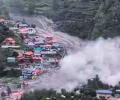
A cloudburst in the high altitude villages of Dharali in Uttarkashi district of Uttarakhand led to flash floods, causing damage to houses and sweeping away structures. Several people are feared buried under debris.
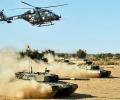
'And this will persist given the two-and-a-half-front threat we face.'
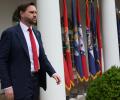
US Vice President J D Vance and National Security Adviser Michael Waltz are scheduled to visit India on April 21, reflecting Washington's focus on strengthening its relationship with India amidst global concerns over President Donald Trump's tariff policy. Vance's visit is likely to be more of a private trip, while Waltz's visit will be a business trip with discussions on security in the Indo-Pacific region, high technology, critical minerals, and export controls. Both are expected to meet Prime Minister Narendra Modi before his trip to Saudi Arabia. The visits come in the wake of Trump's recent pause on tariffs on all countries except China, following widespread economic concerns.
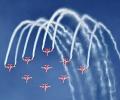
'At Aero India 2025, be prepared to be inspired, awed, and educated,' says Air Commodore Rohith Vijayadev, Air Officer Commanding Yelahanka. 'Aero India 2025 promises to be more than just an air show; it is a celebration of innovation, collaboration, and India's growing leadership in global defence and aviation,' notes Air Commodore Nitin Sathe (retd).
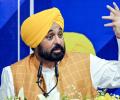
Punjab Chief Minister Bhagwant Mann took a jibe at the Bharatiya Janata Party over Operation Sindoor on Wednesday, saying this is the first time that Indian representatives have been sent abroad to convey about the country's victory in an armed conflict.
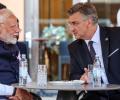
In his media statement following talks with his Croatian counterpart Andrej Plenkovic, Modi said both leaders agree that "terrorism is an enemy of humanity" and is inimical to forces that believe in democracy.

The CIA's confirmation comes amid reports claiming that the US strikes did not destroy nuclear sites in Iran as claimed by President Donald Trump or his administration.

After being launched, the glide bomb steer towards the target using a highly accurate hybrid navigation scheme, the ministry said.

DRDO's failures over the decades have contributed significantly to India becoming the world's biggest weapons importer, points out Lieutenant General Prakash Katoch (retd).

More than one million cybersecurity incidents were flagged within 10 days.
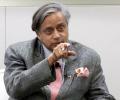
"China is an absolutely impossible factor to ignore in what has been our confrontation with Pakistan," Tharoor said.

'As humans, we haven't changed much'
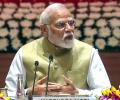
Prime Minister Narendra Modi hailed "Operation Sindoor" as a turning point in the global fight against terror, describing it as a symbol of India's growing strength and clarity of purpose. Addressing the nation through his monthly radio programme Mann Ki Baat, Modi said the operation reflects a changing and resolute India, and has inspired patriotism and self-reliance across the country.
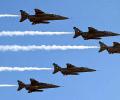
It involves India spending an estimated Rs 40,000 crores to Rs 50,000 crores and will take 10 to 15 years to develop.
The Indian government does not track the number of undocumented Indian immigrants residing in the US. Minister of State for External Affairs Kirti Vardhan Singh, in a written response to a query in the Rajya Sabha, said these immigrants have "legally exited India" but have either overstayed their visa validity, or have entered the US illegally or without valid documents. The response comes at a time when Prime Minister Narendra Modi is on a two-day visit to the US, during which he will hold a bilateral meeting with President Trump. The two leaders are likely to discuss India-US cooperation in sectors like trade, investment, energy, defense, technology and immigration.

During Operation Sindoor, Indian naval ships, submarines and aircraft were operationally ready and deployed, projecting strength and preparedness to deter any "potential actions from our western adversary" in the maritime domain, Navy chief Admiral Dinesh K Tripathi said on Friday.
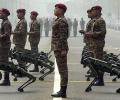
A pet project of the Indian Army, four-legged robotic prototypes have been making waves at the Republic Day and Army Day parades in the past year.
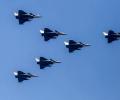
The exercise is taking place at a time when tensions between India and Pakistan have gone up after the Pahalgam attack.

Several multinational medical device makers are focusing on deepening their presence in India by expanding their local manufacturing footprint and research capabilities, a move that can catapult India into a strategic hub for the medical technology (medtech) industry. Among those increasing their reach in the country are Siemens Healthineers and Philips, signalling a broader shift from India being only a sales destination to becoming a global production and innovation base.
Indian Armed Forces brought down a number of these drones using kinetic and non-kinetic means.
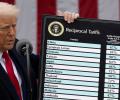
US President Donald Trump has proposed a deal to China that would see the sale of TikTok's US operations to an American buyer in exchange for a reduction in tariffs on Chinese exports to the US. The proposal comes amid a trade war between the two countries and follows China's retaliation of Trump's tariffs on Chinese goods. Trump has also said that tariffs are a powerful economic tool and that he is determined to ensure fair trade between the US and China.
In a first, the 'Aero India' mega event will witness participation of two of the world's most advanced fifth-generation fighter aircraft equipped with stealth capabilities -- the Russian Su-57 and the American F-35 Lightning II, the Defence Ministry said on Sunday.
'When one air force (India's) hits the other's airbases with impunity and that air force (Pakistan's) is not able to respond, then the air force, which has put the other's airbases out of commission, has won.'
India on Friday called on the International Monetary Fund (IMF) to reconsider its $1 billion assistance to Pakistan, suggesting that Islamabad could use it for terror funding.

The total allocation to the defence sector is 12.9 per cent of the total budget of the government of India for the financial year 2024-25.
'The precision strikes were well planned and excellently executed. The world will be studying this operation.'
"It is shocking to note that Turkey, the second-largest arms supplier to Pakistan after China, has played a key role in modernising Pakistan's navy and enhancing its aerial warfare capabilities. "This defence collaboration is not just commercial; it is ideological, targeting the stability of South Asia and emboldening Pakistan's military adventurism," SJM national co-convenor Ashwini Mahajan said in a statement.
'With a military-led strategy to counter terrorism emanating from Pakistan, India has clearly signalled that it would respond decisively to future terrorist threats.'
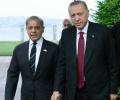
Pakistan Prime Minister Shehbaz Sharif met with Turkish President Recep Tayyip Erdogan to review bilateral relations and reaffirm their commitment to strengthening their strategic partnership. The two leaders discussed joint ventures and enhanced bilateral investment in key sectors, aiming to achieve a $5 billion annual bilateral trade target. They also expressed gratitude for mutual support during recent tensions with India. The meeting was described as "warm and most cordial," highlighting the deep-rooted historical ties between Pakistan and Turkey.
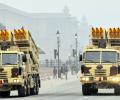
'If you take any ministry of defence project, Nibe is up there, getting orders.'
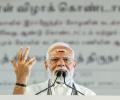
The message from Sunday's event will undoubtedly reverberate globally. It's a landmark occasion that will be remembered for generations and will inspire many other states to introduce the story of Rajendra Chola into school curricula, says Tarun Vijay.
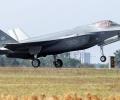
We need to equip the Indian Armed Forces, not 'commercial' as Trump wants, but 'operationally' looking at growing Chinese military capabilities, asserts Lieutenant General Prakash Katoch (retd).

Congress leader Uttam Kumar Reddy said the country wanted to know whether any aircraft were downed during the conflict, especially in the wake of the CDS' "admission".
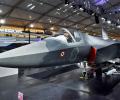
If I were to explain stealth to a layperson, I'd ask them to think of the game chupan-chupai (hide and seek) we played as children, explains Air Commodore Nitin Sathe (retd).

Union Home Minister Amit Shah said on Friday that the Operation Sindoor undertaken by the Indian armed forces in retaliation for the Pahalgam terror attack has "completely exposed" the fact that terrorism in India is sponsored by Pakistan. Shah also said that the operation showed the "firm" political will of Prime Minister Narendra Modi, the "precise" intelligence inputs from agencies, and the "lethal" capabilities of the armed forces. He added that the operation was successful as it used the correct firepower and achieved its aims besides "showing the reality" to Pakistan.

Indian astronaut Shubhanshu Shukla stands on the cusp of history as he prepares to set off on a space odyssey, marking India's return to space flight 41 years after his idol Rakesh Sharma orbited the earth for eight days as part of Soviet Union's Interkosmos programme.
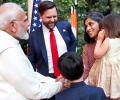
Prime Minister Narendra Modi and US Vice President JD Vance have expressed satisfaction with the progress made in negotiations for a bilateral trade agreement. The two leaders met in New Delhi and discussed a range of bilateral issues, including cooperation in energy, defense, strategic technologies, and other areas. They also exchanged views on regional and global issues of mutual interest.
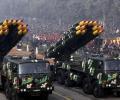
Defence exports grew 33 per cent in the calendar year 2023 (CY23) to around Rs 21,083 crore while domestic defence orders serviced by listed companies were Rs 48,000 crore. The sector is poised for steady growth. Budgeted domestic capex is likely to hit Rs 3 trillion per annum, and exports could reach $6 billion by FY29.
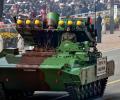
The defence budget was on Thursday increased to Rs 6.21 lakh crore for 2024-25 in a modest hike of 4.72 per cent from last year's allocation of Rs 5.25 lakh crore amid India's continuing border row with China in eastern Ladakh as well as concerns over evolving security situation in the strategic waterways.
